
Mini Christmas concert for animals
Voice and guitar gave life to a small concert behind closed doors: here's how giraffes, chimpanzees and the others responded
Voice and guitar gave life to a small concert behind closed doors: here's how giraffes, chimpanzees and the others responded
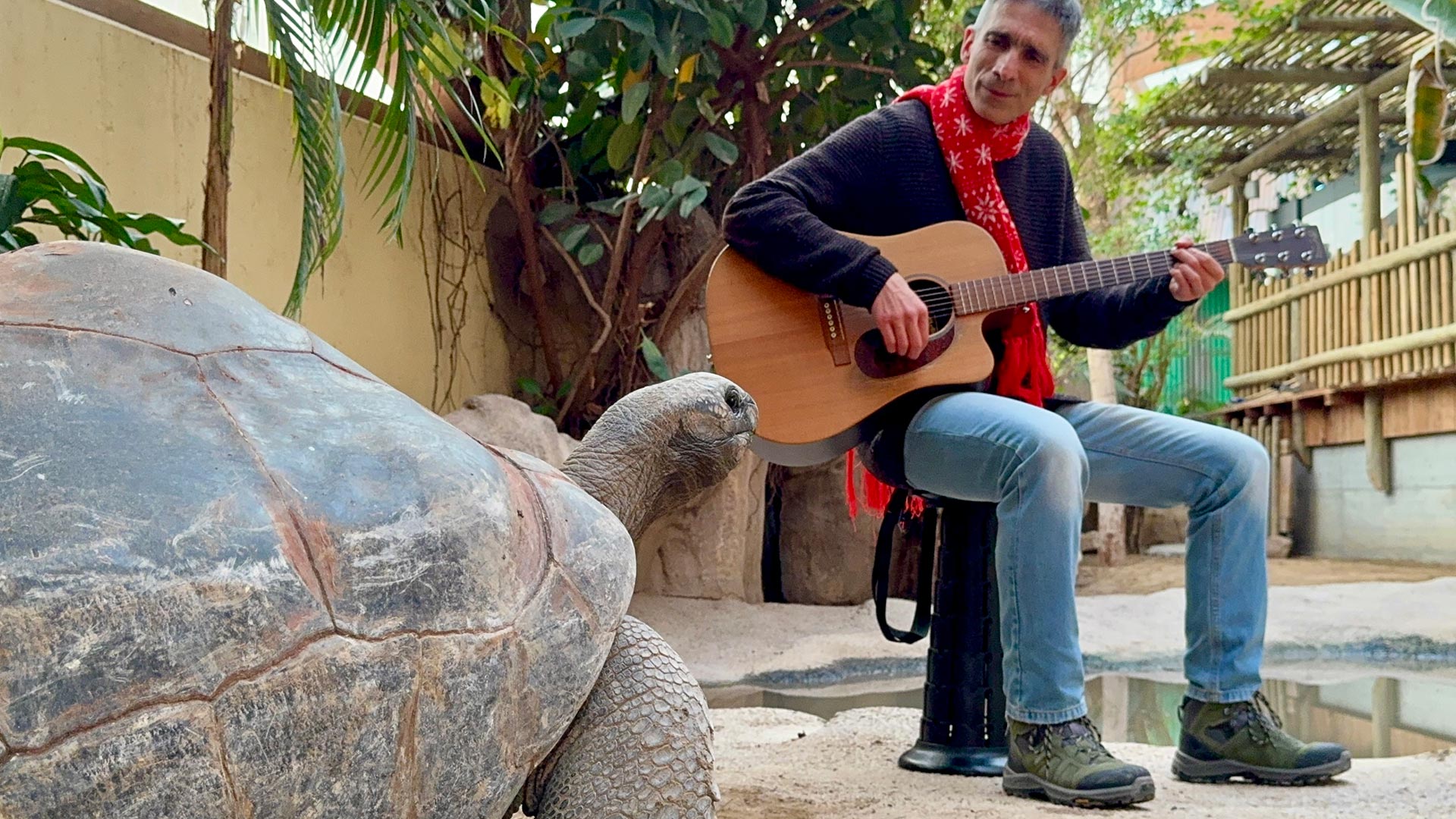
Not the usual unwrapping of presents. But a Christmas concert, acoustic and behind closed doors, dedicated exclusively to animals. Riding a pickup truck among giraffes, on a stool among giant tortoises, or sitting among lemurs soaking up the sun: two musicians, with voice and guitar, brought the melodies of the year's most magical season right into their habitats, at the Natura Viva park in Bussolengo and the Zoom Turin biopark. Eight species were involved, and not only did they offer an unusual environmental enrichment activity. The initiative was also supervised by researchers from the Zoom Foundation, in collaboration with the Universities of Parma and Padua, to evaluate the animals' behavioral responses to Christmas carols, performed with just instruments and voices. Michele Negrini (aka Michele Mud) and Ivan Ottolini (aka Ivan Wildboy) played guitar.
Jingle Bells, Feliz Navidad, White Christmas, and Silent Night were the most frequently performed songs for the animals, characterized mostly by linear melodies and repetitive rhythms. The cautious curiosity of the giraffes, capable of sustaining attention for several minutes, alternated with the total relaxation of the giant tortoises, which even indulged in moments of rest. The same occurred with the Komodo dragon, while the initial distrust of the chimpanzees later gave way to curiosity, some of which nevertheless observed the musician from above. The lemurs, on the other hand, let the Christmas concert accompany them during their sunbathing, positioning themselves as close as possible to the melody. Special mention goes to the three baby reindeer, who are not yet one year old: accompanied by their four adults, they displayed the exploratory curiosity typical of their age. The farm animals rounded off the performance with a flourish, with alpacas and llamas intrigued by the unusual presence and the objects the musician was carrying. The study will continue until Epiphany, to see if this time it will be possible to provide a scientific framework for animal behavior in the presence of music.
"This is an area of research already underway at both the Natura Viva park and the Zoom Turin biopark, in collaboration with other Italian universities," explains Caterina Spiezio, head of Animal Research at the Zoom Foundation. "In the former case, over the years we have studied the responses of macaques and lemurs to exposure to different musical genres, which have shown that macaques are more sociable with each other when listening to classical and new age music, but less so when listening to pop. Country music, on the other hand, promotes greater activity in lemurs. More recently, a study gave chimpanzees the option of turning on or off two possible tracks with different rhythmic patterns by choosing to pull only one string. At the Zoom Turin biopark, however," the psychobiologist continues, "studies conducted with meerkats, Asian otters, and African penguins have shown that some mammals, in the presence of classical music, relaxed, displaying restful and comfortable behaviors. Conversely, penguins, regardless of the musical genre, showed greater alertness to their surroundings." This is an area of study that is still partly to be explored, but which could lead to considering music as a useful tool for animals too, if applied and evaluated scientifically by species and by individual.